
Your homogenizer suffers from unstable performance and frequent downtime. This costs you money, disrupts production, and can even compromise the quality of your final product.
Stellite alloys provide superior resistance to wear, cavitation, and impact in the extreme conditions found inside a homogenizer. Using Stellite for critical valve parts extends component life, ensures stable operating pressure, and improves the consistency and quality of your product.
When I talk with maintenance managers, they often blame high pressure for their homogenizer problems. It’s an easy assumption to make. But in my experience, pressure is only part of the story. The real issues are far more complex and aggressive. To truly solve the problem of premature part failure, we need to look deeper into what really happens inside these powerful machines. Let’s break down why they are so demanding on materials.
Why do High-Pressure Homogenizers Require Advanced Valve Materials?
Your homogenizer parts are wearing out much faster than you expect. You keep replacing them, but the same failures happen again and again, which is frustrating and costly.
Homogenizers are not just high-pressure vessels. They are complex systems that create extreme fluid erosion, high-frequency impacts, and demand perfect micro-gap sealing. These combined forces quickly destroy standard materials, making advanced alloys essential for reliable and consistent performance.
I’ve learned to think of a high-pressure homogenizer as a system of controlled violence. It’s not just about squeezing a liquid. It’s about forcing that liquid at incredible speed through an extremely narrow, adjustable gap. The goal is to break down particles and create a stable emulsion. But this process unleashes a host of destructive forces that go far beyond what simple pressure vessels experience.
More Than Just Pressure
The pressure itself is a static force. The real damage comes from the dynamic forces created when that pressure is released. Imagine the liquid accelerating to hundreds of meters per second as it passes through the valve gap. This creates a jet of fluid that acts like a sandblaster on the valve surfaces. At the same time, the valve is opening and closing at very high frequencies, creating a constant hammering effect. A standard material simply cannot hold its shape or surface finish under this combined assault. This is why we need materials designed specifically for this environment.
What are the Common Failure Mechanisms in Homogenizer Valve Parts?
You see a failed valve part, but you are not sure about the exact cause. Is it wear, corrosion, or cracking? This uncertainty makes it hard to find a permanent solution.
The most common failures are not simple wear. They include high-velocity fluid erosion, cavitation damage from collapsing vapor bubbles, and fatigue from constant high-frequency impacts. Micro-particle abrasion from the product and corrosion from cleaning cycles also destroy the parts.
Over the years, I’ve inspected countless failed homogenizer parts for clients. The damage patterns almost always point to a combination of destructive forces working together. It’s rarely just one thing. Pressure alone doesn’t create the pits, grooves, and cracks we see. To choose the right material, you first have to understand what you’re fighting against. These are the main enemies of your valve components:
| Failure Mechanism | Description |
|---|---|
| High-Velocity Erosion | The fluid accelerates as it is forced through the tiny valve gap, acting like a liquid jet that blasts away the surface of the valve and seat. |
| Cavitation | As the fluid exits the high-pressure gap, the pressure drops suddenly. This causes tiny vapor bubbles to form and then immediately collapse with incredible force, hammering and pitting the metal surfaces. |
| High-Frequency Impact | The valve plug or ball is constantly impacting the valve seat thousands of times per minute. This creates cyclic stress that can lead to fatigue cracking and surface deformation. |
| Micro-Particle Abrasion | If the product contains any hard or abrasive particles, they get trapped in the valve gap and grind away at the sealing surfaces like sandpaper. |
| Corrosion | Aggressive cleaning and sterilization chemicals (CIP/SIP) can attack the material, especially when combined with high temperatures and erosion. |
Any one of these forces is tough on a material. When they all happen at the same time, it creates one of the most severe industrial environments I know.
Why does Stainless Steel Often Fail in Severe Homogenization Conditions?
You tried using high-grade stainless steel parts, maybe even hardened ones, but they still failed quickly. It feels like you wasted money on a solution that didn’t solve the core problem.
While strong and corrosion-resistant, most stainless steels lack the unique combination of properties needed for homogenizers. Under high-frequency impact and intense erosion, their surfaces deform or pit. This damage quickly ruins the delicate sealing face, leading to pressure loss and rapid failure.
I often get questions from clients asking why the expensive stainless steel parts they bought didn’t last. It’s a fair question. Stainless steel is a fantastic material for many applications, especially in the food and pharmaceutical industries, because it’s clean and resists general corrosion. However, it has a critical weakness in this specific application. It lacks what we call “hot hardness” and superior galling resistance. The intense, localized energy at the homogenizer valve tip can create microscopic hot spots, and the material’s surface just isn’t hard enough to resist the combination of impact and erosion. The surface starts to wear away, the seal is lost, and the efficiency of the homogenizer plummets. It’s simply not the right tool for the job, no matter how high the grade of steel.
What Makes Stellite the Superior Choice for Homogenizer Valves?
You need a material that can withstand everything a homogenizer throws at it. Finding a single material that resists wear, impact, and corrosion all at once can be difficult.
Stellite’s real value isn’t just its hardness. It’s the unique ability to keep a stable seal and a smooth surface under constant erosion and high-frequency impact. This special cobalt-chromium alloy provides an unmatched combination of wear, corrosion, and heat resistance.
When we recommend Stellite, we’re not just suggesting a “harder metal.” The magic of Stellite alloys is in their fundamental structure. They are made from a cobalt base, with chromium for corrosion resistance and tungsten carbides for extreme hardness.
The Secret is in the Microstructure
Think of it like reinforced concrete. The hard tungsten carbide particles are like the super-hard gravel, and the tough, slightly “slippery” cobalt matrix is like the cement holding it all together. This structure does a few amazing things. The hard carbides resist abrasive wear and erosion. The tough cobalt matrix absorbs the shock from high-frequency impacts without cracking. And the inherent properties of cobalt make it resistant to galling or “sticking” under high pressure. This is why a Stellite part can maintain its precise shape and mirror-like surface finish for so much longer than any steel. It’s an engineered solution designed from the atomic level up for this exact challenge.
What are the Common Stellite Components in Homogenizers?
You are convinced that Stellite is the answer for your homogenizer. But which specific parts will give you the best return on investment when you upgrade them?
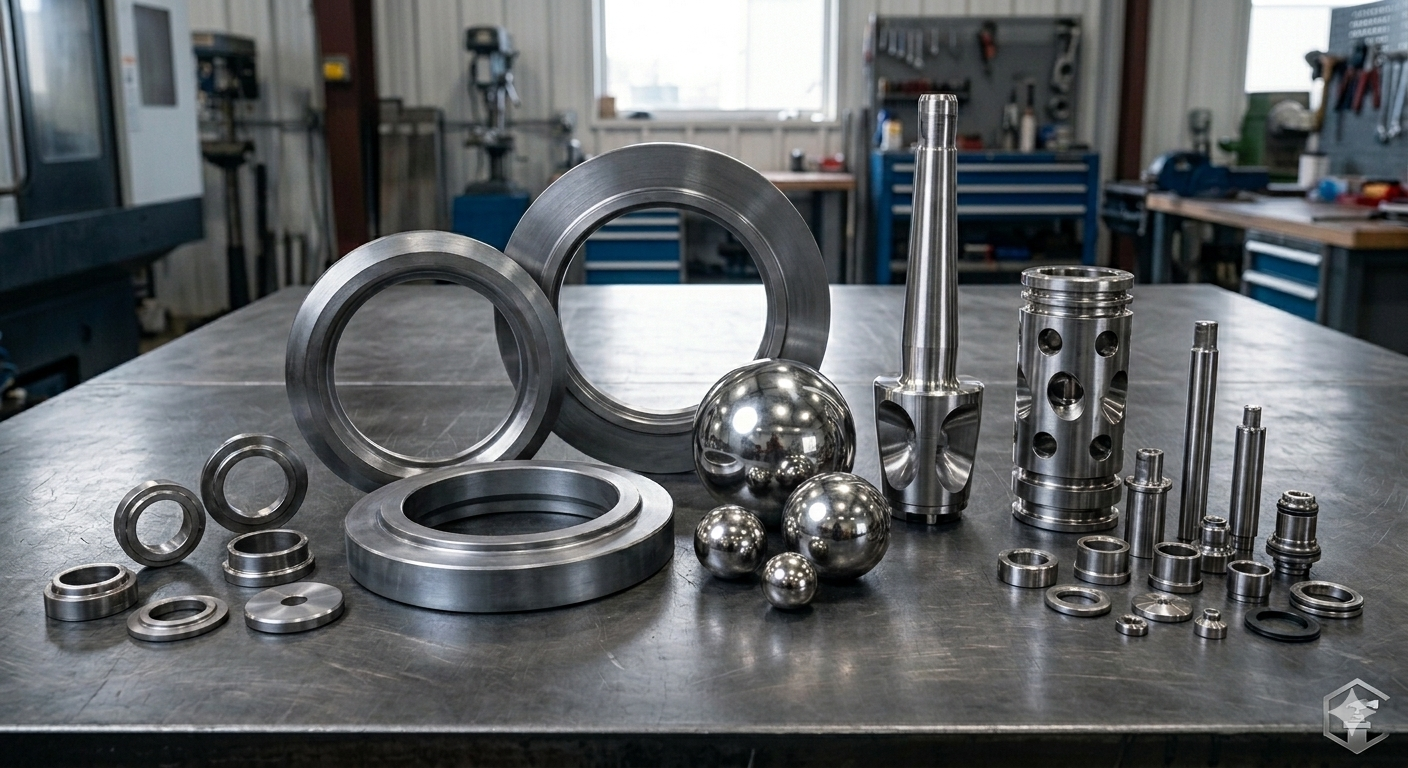
You should focus on the components that form the heart of the homogenizing valve assembly. These are the parts that take the most abuse. They include the valve seat, the valve plug (or poppet/ball), and sometimes an impact ring.
- Valve Seat: This is the stationary part that the valve plug seals against. Its sealing face must remain perfectly flat and smooth. Stellite ensures the seat resists the erosive fluid jet and the constant hammering from the plug, preventing leaks and maintaining stable pressure.
- Valve Plug (or Poppet/Ball): This is the moving part that controls the flow and creates the pressure drop. It experiences extreme impact and fluid forces. A Stellite plug will not deform, pit, or wear down, ensuring the gap remains consistent for uniform homogenization.
- Impact Ring: In some designs, this component sits opposite the valve seat and absorbs the energy of the fluid jet. Making it from Stellite prevents it from eroding or cracking, which protects the rest of the valve body.
By upgrading this core group of components, you are reinforcing the area where nearly all the destructive work is done.
How does Stellite Compare to Stainless Steel in Homogenizer Applications?
You need to explain to your procurement manager or your boss why Stellite parts are worth the higher initial cost. Just saying “it’s better” is not enough to justify the budget.
A direct comparison makes the choice clear. Stellite dramatically outperforms stainless steel in every key area for homogenizer performance: wear, cavitation, and impact resistance. While stainless steel is cheaper upfront, Stellite’s much longer life results in a lower total cost of ownership.
| Property | Standard Stainless Steel | Stellite Alloy | Why It Matters for a Homogenizer |
|---|---|---|---|
| Wear & Erosion Resistance | Fair | Excellent | Resists the high-velocity fluid jet, maintaining the valve gap. |
| Cavitation Resistance | Poor to Fair | Excellent | Prevents pitting and surface destruction from collapsing bubbles. |
| Impact Toughness | Good | Excellent | Absorbs the constant hammering of the valve without cracking or deforming. |
| Hot Hardness | Fair | Excellent | Maintains hardness even at the high localized temperatures at the valve tip. |
| Sealing Integrity | Degrades Quickly | Stays Stable | Keeps a perfect seal to maintain consistent pressure and product quality. |
| Initial Cost | Low | High | Stellite is a premium material, so the initial part cost is higher. |
| Total Cost of Ownership | High | Low | Fewer replacements, less downtime, and stable production make Stellite cheaper over time. |
When a client switches to Stellite, they stop buying replacement parts every few months. They start buying them once every year or two. The math on that is very simple.
How does Stellite Improve Equipment Life and Process Stability?
You want to improve both machine reliability and the quality of your product. It often feels like you have to focus on one or the other, but you need both.
By using Stellite parts, homogenizers run much longer between maintenance cycles. This increased uptime directly boosts productivity. More importantly, the stable performance ensures consistent pressure, leading to uniform particle size and reliable product quality.
The benefits of using the right material go far beyond just having parts that last longer. It has a direct impact on your operations and your bottom line. We have seen this with dozens of clients in the food, dairy, and pharmaceutical industries.
Longer Component Service Life
The most obvious benefit is that the parts simply last longer. Because Stellite is fundamentally resistant to the wear, impact, and cavitation inside the homogenizer, service life can increase by 3, 5, or even 10 times compared to standard materials. This means fewer shutdowns for maintenance.
Improved Process Stability
This is the most important benefit for product quality. A worn valve cannot hold a steady pressure. The pressure fluctuates, and so does the particle size of your product. This leads to inconsistent texture, separation in emulsions, and batches that are out of specification. Because Stellite parts maintain their shape, they hold pressure steady. This means your product quality is consistent from the start of the batch to the end, day after day. This reliability is critical in regulated industries like food and pharma.
Conclusion
Stellite is not just a harder material. It’s a complete solution for the combined challenges of homogenizers, ensuring equipment reliability, longer life, and most importantly, consistent product quality.