
Struggling with frequent valve failures in your toughest applications? This leads to costly downtime and operational headaches. Stellite alloys offer a proven, long-lasting solution for severe service conditions.
Stellite is ideal for severe service valves because its unique cobalt-chromium alloy structure provides exceptional hardness, corrosion resistance, and strength at high temperatures. This combination directly combats the wear, erosion, and galling that cause standard valves to fail in demanding industrial environments.
I’ve worked with many procurement and maintenance managers over the years. A common story I hear is the constant battle with valves in critical systems. They leak, seize, or simply wear out far too quickly. It’s a frustrating cycle of replacement and unplanned shutdowns. But I’ve also seen the relief when they switch to components made with Stellite. It really changes the game for them. Let’s dive into exactly why this material makes such a big difference in these harsh environments.
How does Stellite resist wear and galling in valves?
High pressure and metal-on-metal contact in valves can cause surfaces to seize. This galling leads to leakage, performance loss, and ultimately, a completely stuck valve.
Stellite resists wear and galling because of its naturally low friction and high hardness, which it maintains even at high temperatures. Hard carbide particles within the alloy prevent metal surfaces from welding together under pressure, ensuring smooth operation and a tight seal for a long time.
To really understand this, we need to look at the material’s structure. Stellite isn’t just one material; it’s a family of cobalt-chromium alloys. Think of it like a concrete road. You have the main binder (the cobalt matrix) and hard stones mixed in (the tungsten and chromium carbides). This structure is the key.
The Science Behind Galling Resistance
Galling is a form of wear caused by adhesion between sliding surfaces, especially under high loads. It’s like cold welding on a microscopic level. The surfaces stick and tear, creating damage that gets worse very quickly. Stellite’s cobalt matrix is inherently slick and resistant to this type of adhesion. The hard carbide particles act like tiny ball bearings, keeping the surfaces separated and allowing for smooth movement, even when the valve is under immense pressure. This is why it’s a top choice for valve seats, plugs, and stems, where tight contact and movement are constant.
Comparing Materials for Valve Trim
When you compare Stellite to other common materials, the difference is clear.
| Feature | 316 Stainless Steel | Stellite 6 |
|---|---|---|
| Typical Hardness (HRC) | ~20 | ~40 |
| Galling Resistance | Poor to Fair | Excellent |
| Primary Failure Mode | Galling, Pitting | High-Impact Fracture |
| Best Use Case | General Service | Severe Service, High Pressure |
For years, I saw clients use hardened stainless steels, but they would still face galling issues. Once we helped them source valve trim with a Stellite 6 overlay, the problem often disappeared.
Can Stellite withstand high temperatures and thermal shock?
Most metals get soft and weak when they get very hot. In a power plant or refinery, this can cause a valve to deform, leak, and fail catastrophically.
Yes, it can. Stellite alloys are famous for their “hot hardness,” which means they keep their strength and wear resistance at temperatures up to 800°C (1500°F). This stability prevents failure in high-temperature steam, exhaust, or chemical processes, ensuring the valve works reliably.
The term “hot hardness” is critical here. It’s not just about not melting. It’s about a material’s ability to stay hard and resist wear when it’s glowing red-hot. This is where cobalt-based alloys like Stellite truly shine and outperform most stainless steels and even many nickel-based alloys.
Why Hot Hardness Matters
Think about the valves controlling superheated steam in a power station. The temperatures are extreme, and so is the pressure. A material that softens will quickly wear away or become deformed, leading to dangerous leaks. Stellite’s stable atomic structure allows it to maintain its integrity. I remember a client at a power generation facility who was replacing main steam control valves every six months. After we coordinated the supply of new seats with a Plasma Transferred Arc (PTA) welded Stellite 6 overlay, those same valves have now been in service for over three years without any issues.
Hot Hardness Comparison
The data clearly shows why Stellite is superior for hot applications.
| Temperature | 410 Stainless Steel Hardness (HRC) | Stellite 6 Hardness (HRC) |
|---|---|---|
| Room Temp | ~42 | ~40 |
| 540°C (1000°F) | ~25 | ~32 |
| 650°C (1200°F) | ~10 | ~28 |
What about Stellite’s performance against corrosion and erosion?
Corrosive chemicals and high-speed particles can eat away at valve components. This leads to leaks, process contamination, and serious safety hazards in chemical plants and pipelines.
Stellite’s high chromium content forms a tough, self-repairing oxide layer that resists corrosion from acids and chlorides. This, combined with its inherent hardness, makes it excellent at withstanding erosion from abrasive particles in slurries or high-velocity steam, protecting critical sealing surfaces.
In many severe service applications, it’s not just one problem; it’s a combination of challenges. You might have a corrosive fluid that also contains abrasive solids. This is where Stellite’s dual resistance to both corrosion and erosion becomes so valuable.
The Role of Chromium and Cobalt
The hero in the fight against corrosion is chromium. When exposed to oxygen, the chromium in the Stellite alloy forms a very thin, invisible, and incredibly tough layer of chromium oxide on the surface. If this layer gets scratched or damaged, the chromium in the alloy immediately reacts with the environment to “heal” it. This passive film protects the underlying cobalt from attack by a wide range of chemicals, including sulfuric acid, chlorides, and sour gas (H2S). The cobalt matrix itself also has good corrosion resistance, making the combination very powerful.
Combating Erosion-Corrosion
Erosion-corrosion is a worst-case scenario. Abrasive particles (like sand or catalyst fines) in a fluid stream physically blast away the protective passive layer on a metal’s surface. This exposes fresh, unprotected metal to the corrosive fluid, which then attacks it. The process repeats, leading to extremely rapid material loss. Because Stellite is so hard, it’s much more difficult for abrasive particles to remove material in the first place. Its ability to resist the physical damage of erosion allows its excellent corrosion resistance to keep doing its job, breaking the cycle of rapid wear. This makes it perfect for slurry valves, catalyst handling lines, and fluid catalytic cracking (FCC) units.
How are Stellite components applied to valves?
You might think that because Stellite is so effective, a solid Stellite valve would be the answer. But that would be incredibly expensive and often unnecessary for the whole valve.
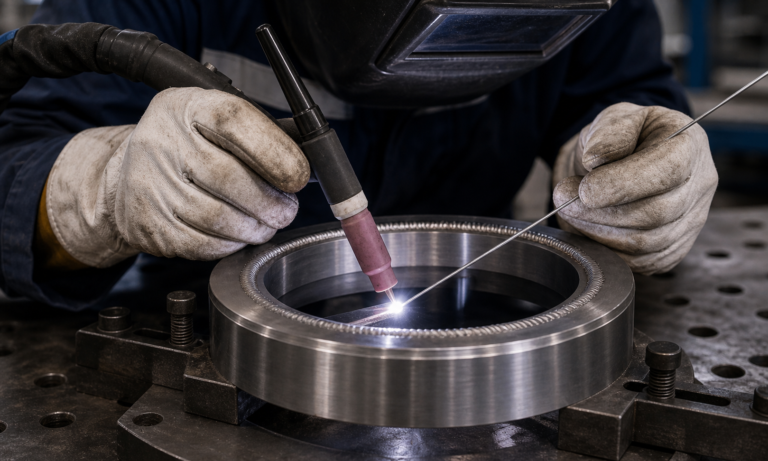
Stellite is usually applied as a hardfacing overlay on the most critical areas of a valve, like the seats and ball. This is done using welding processes like PTA or TIG. It can also be cast into solid components for smaller, high-wear parts.
The most common and cost-effective strategy is to make the valve body from a standard material like carbon steel or stainless steel, and then strategically apply Stellite only on the surfaces that see the most wear. This gives you the best of both worlds: the performance of Stellite right where you need it, at a much more manageable cost. As a sourcing company, we help our clients connect with manufacturers who have the specialized equipment and expertise to perform these application processes correctly.
Hardfacing for Targeted Protection
Hardfacing is the process of depositing a layer of hard, wear-resistant material onto a component. For Stellite, this is usually done with welding.
- Plasma Transferred Arc (PTA) Welding: This is often the best method. It uses a high-energy plasma torch to create a very clean, high-quality weld overlay with minimal dilution from the base metal. This ensures the Stellite deposit has the pure properties needed for maximum performance.
- Tungsten Inert Gas (TIG) Welding: A very common and precise manual method, great for repairs or complex geometries.
- Laser Cladding: A modern, highly controlled process that produces excellent results with very low heat input, reducing the risk of distortion in the part.
Solid Cast vs. Overlay
Sometimes, an overlay isn’t practical. For smaller components like valve seats, balls, or bushings, it can be more effective to cast them from solid Stellite alloy. These precision investment castings provide a homogenous component with Stellite properties through and through. The choice between an overlay and a solid casting depends on the part’s size, geometry, and the specific stresses it will face in service.
| Application Method | Best For | Key Advantage |
|---|---|---|
| PTA Overlay | Large surfaces, valve seats, gates | Low dilution, high purity deposit |
| Solid Casting | Small, complex parts, balls, seats | Homogenous material properties |
| TIG Overlay | Repairs, intricate areas | High precision and control |
Conclusion
Stellite excels against wear, heat, and corrosion. For severe service valves, using it isn’t just an upgrade; it is a long-term investment in reliability and lower operational costs.