
If you are still deciding whether to move from carbide to a cobalt alloy, first read Are Stellite Saw Tips the Upgrade for Woodworking Saws?. This article begins one step later: you already see a reason to use Stellite, but need to avoid ordering the wrong grade or product form.
Start with the Failure You Are Paying For
Purchasing sees the unit price of each tip. The saw shop experiences the full cost: stopping the machine, removing the blade, rebuilding or replacing teeth, grinding, setting, and bringing the blade back into stable production. A technically correct grade is the one that reduces the actual failure mode without creating a new one.
| What you see on the blade | First issue to investigate | Grade decision |
|---|---|---|
| Edges round over gradually; no major chipping | Abrasive wear from the wood, bark, sand, or operating conditions | A harder grade may help; Alloy 1 can be evaluated against Alloy 12. |
| Tips chip or crack at knots, frozen bark, or impact | Toughness, tooth geometry, joining stress, or excessive hardness | Do not move to Alloy 1 automatically; Alloy 12 is usually the safer starting direction. |
| Tips detach while the cutting edge still looks usable | Seat preparation, cleanliness, tinning or filler, heating cycle, and joint design | Grade is not the first fix. Correct the joining system before comparing alloys. |
| Wear varies across the same blade or cut quality drifts | Blade alignment, tensioning, feed, grinding, tooth set, or inconsistent geometry | Confirm setup and dimensional consistency before blaming alloy chemistry. |
Why Stellite 12 Is the Practical Starting Grade
Stellite 12 saw tips are widely used because they sit between a general-purpose cobalt wear alloy and the much harder Alloy 1. Manufacturer data describes Alloy 12 as a cobalt-chromium-tungsten alloy with nominal 29% chromium, 8.5% tungsten, and 1.8% carbon, with typical hardness of 46-51 HRC. These are reference values, not universal acceptance limits.
For a sawmill, the important point is the balance behind those numbers. Alloy 12 has enough carbide content to resist sliding and abrasive wear, while retaining more impact tolerance than Alloy 1. Kennametal identifies its Alloy 12 saw grade for circular and band saws cutting green, frozen, and kiln-dried lumber, including primary, trim, edger, and high-impact positions. Deloro also lists timber saw tips as a specific Alloy 12 application.
Choose Alloy 12 first when wood condition changes during a shift, knots and impact cannot be eliminated, or the current teeth sometimes chip rather than simply wear smooth. It is not the soft option; it is the lower-risk balance when production conditions are not perfectly controlled.
When the Extra Hardness of Stellite 1 Can Pay Off
Stellite 1 contains a higher proportion of primary carbides. Deloro lists nominal 30% chromium, 13% tungsten, and 2.5% carbon, with typical hardness of 51-60 HRC. This can improve resistance to severe abrasion and low-angle erosion, but the same microstructure reduces toughness and increases crack sensitivity. The material is normally finished by grinding.
Alloy 1 deserves a controlled trial when your Alloy 12 teeth wear gradually and predictably, the wood or contamination is strongly abrasive, and the saw is not already losing teeth through chipping or joint failure. It is a poor response to impact damage. A harder tooth that breaks early does not lower cutting cost.
Quick Grade Comparison for Buyers
| Decision factor | Alloy 12 | Alloy 1 |
|---|---|---|
| Typical hardness | 46-51 HRC | 51-60 HRC |
| Best starting condition | Mixed wear and intermittent impact | Dominant severe abrasion with controlled impact |
| Main advantage | Balance of wear resistance and toughness | Higher carbide content and abrasion resistance |
| Main risk | May wear faster than Alloy 1 in strongly abrasive service | Lower toughness and higher crack sensitivity |
| Finishing | Grinding is commonly used for final tooth geometry | Grinding is normally required |
Important: The quoted chemistry and hardness are nominal or typical manufacturer data. Your drawing, purchase specification, product form, test method, and material certificate should define acceptance.
Why the Phrase ‘Stellite Saw Teeth’ Can Produce the Wrong Quote
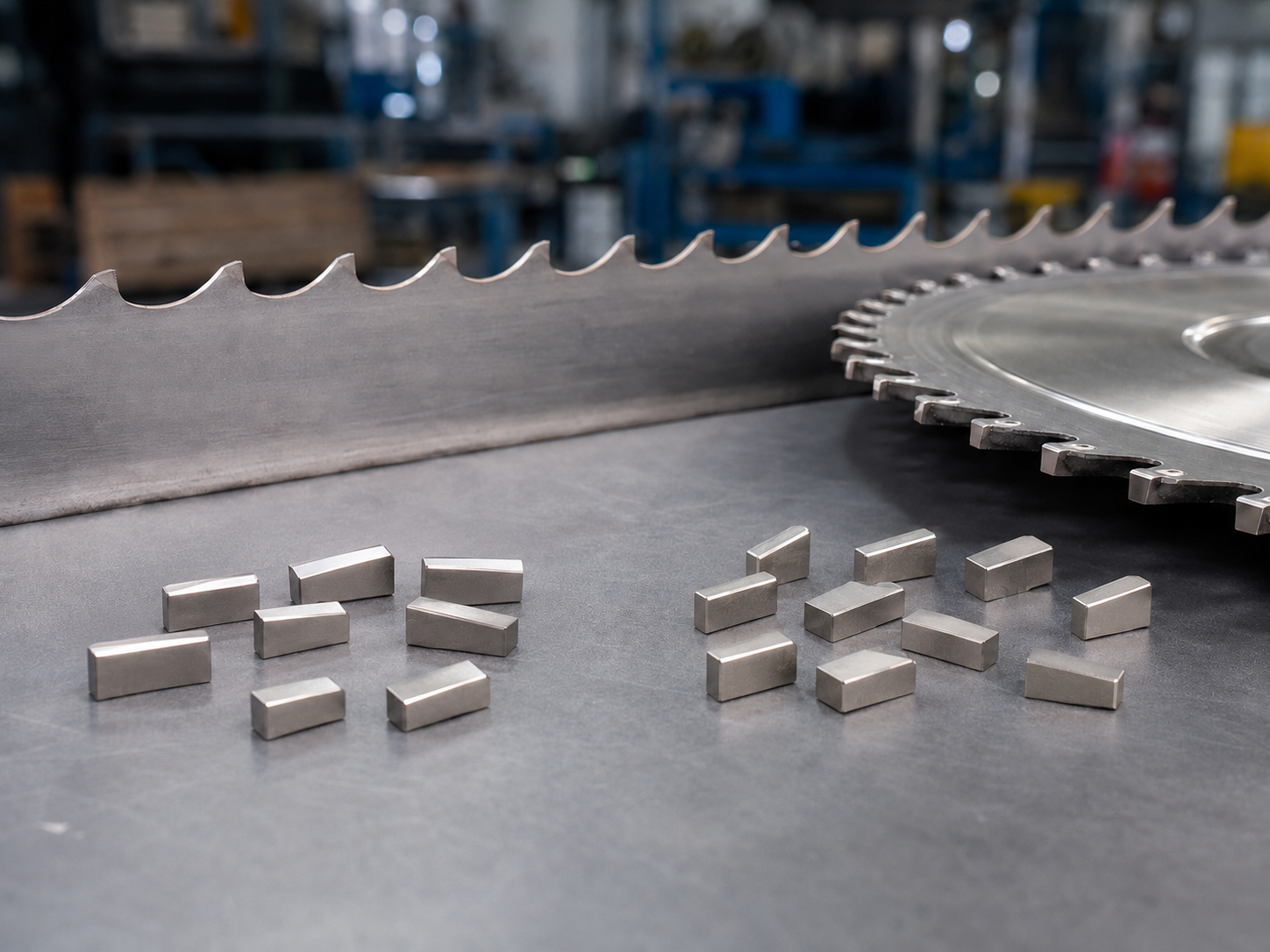
A supplier cannot reliably quote from the grade name alone. Stellite saw teeth may mean discrete preformed tips joined to a steel blade, teeth built from shaped rod or strobe, or deposited teeth made from spooled wire. These routes need different dimensions, joining processes, finishing allowances, inspection plans, and packaging.
The keyword “Stellite 1 saw tips” needs particular care. Some forestry catalogs list Alloy 1 for saw cutting in spooled wire form rather than as the same preformed-tip configuration offered in Alloy 12. If your process requires finished tips, say so explicitly. If your saw shop builds the teeth from wire, specify the wire form and process instead.
What We Need to Quote the Right Saw Tip
When we review a saw-tip inquiry, the drawing is only the beginning. The following information lets us separate a material problem from a geometry or joining problem and prepare a quotation that matches the actual saw.
- Saw type and position: band or circular saw; primary, resaw, trim, or edger application.
- Current symptom: gradual dulling, chipping, cracking, tip loss, uneven wear, or poor cut quality.
- Wood and contamination: species, green/frozen/kiln-dried condition, bark, sand, stones, or possible metal contamination.
- Required product form: preformed tip, shaped rod or strobe, spooled wire, or finished Stellite saw teeth.
- Drawing and dimensions: profile, length, width, thickness, seat geometry, angles, radii, tolerances, and grinding allowance.
- Joining and supply condition: brazing, welding, or deposited-tooth process; untreated, pre-tinned, ground, or pre-sharpened condition.
- Acceptance requirements: agreed grade, hardness range and test method, chemistry documentation, lot traceability, inspection, and certification.
- Commercial information: sample quantity, production quantity, destination, packaging, and required delivery timing.
Qualify the Change Before You Risk a Production Blade
Changing from Alloy 12 to Alloy 1 should be treated as a controlled process change, not a catalog substitution. The tip material, joint, grinding practice, tooth geometry, and saw settings work as one system.
- Confirm the supplied product form, grade documentation, dimensions, surface condition, and lot identity.
- Validate the joining or tooth-building process on representative samples and inspect for cracks, porosity, and incomplete bonding.
- Verify hardness using the agreed method and sampling plan; do not rely on one isolated reading to identify the grade.
- Run Alloy 12 and Alloy 1 under comparable conditions, then record wear shape, chipping, tip loss, cut quality, and time between service events.
- Choose the grade that reduces total service interruption and blade risk, not simply the grade with the highest hardness number.
Frequently Asked Questions
Which grade should I try first if my current tips keep chipping?
Do not respond by increasing hardness first. Check impact, tooth geometry, the joining cycle, residual stress, and blade setup. Between the two grades, Alloy 12 is normally the safer starting direction because Alloy 1 is less tough and more crack-sensitive.
Are Stellite 1 saw tips always longer lasting than Stellite 12 saw tips?
No. Alloy 1 can last longer when gradual abrasion controls service life, but it can fail sooner when impact, chipping, or joint damage controls service life. The worn tooth tells you more than the hardness ranking.
Are Stellite saw tips and Stellite saw teeth the same product?
Not always. Tips are usually discrete pieces, while saw teeth can also be created from shaped material or wire. State the required product form, joining route, and finished geometry in the RFQ.
Can I approve a batch from hardness alone?
No. Hardness does not verify chemistry, dimensions, joint quality, or traceability. Use the purchase specification, material documentation, hardness results, dimensional inspection, and a representative cutting trial together.
Discuss Your Stellite Saw Tip Failure with Us
Send an inquiry using the form on this page and tell us what the worn teeth actually look like. For the fastest response, contact us on WhatsApp at +86 136 7477 1335 or email sales@stecometals.com. We respond to technical inquiries within 24 hours.
For an accurate first quotation, send the grade if already specified, required hardness, product form, drawing and dimensions, surface or tinning condition, quantity, saw type, wood condition, photos of the worn or failed teeth, current service problem, destination, and certification requirements. A sample lot can be arranged before a production order; material and hardness certificates are available with each batch.
Technical Sources
- Kennametal, Tungsten Carbide & Stellite Saw Tips – grade applications, hardness, product forms, and treatment options.
- Kennametal, Tungsten Carbide and Stellite Saw Tips Catalog – forestry portfolio and saw-tip configurations.
- Deloro Wear Solutions, Stellite 12 Material Data Sheet – nominal composition, hardness, product forms, and timber saw-tip application.
- Deloro Wear Solutions, Stellite 1 Material Data Sheet – nominal composition, hardness, abrasion behavior, toughness limitation, and finishing guidance.