
Why the Powder Specification Matters More Than the Grade
When buyers source stellite powder, chemistry is usually the first question asked and the last one that causes problems. Two lots of Stellite 6 powder can be chemically identical and still behave completely differently in your equipment: one feeds smoothly and produces a dense, well-bonded coating, while the other bridges in the hopper and deposits porous. The difference lies in particle size distribution, particle morphology, and flowability – the properties that govern how powder behaves between the feeder and the substrate.
This guide covers what to specify when purchasing stellite 6 powder and other cobalt-based hardfacing powders, and why matching the powder to your deposition process matters as much as matching the alloy to your wear environment.
Stellite 6 Powder: Composition and Deposited Properties
Stellite 6 is a cobalt-chromium-tungsten alloy with a nominal chemistry of Co balance, Cr 27-32%, W 4-6%, and C 0.9-1.4%, with nickel, silicon, iron, and manganese present as minor constituents. The alloy owes its performance to chromium-rich carbides distributed in a cobalt solid-solution matrix: the carbides provide wear resistance, while the matrix supplies toughness and corrosion resistance.
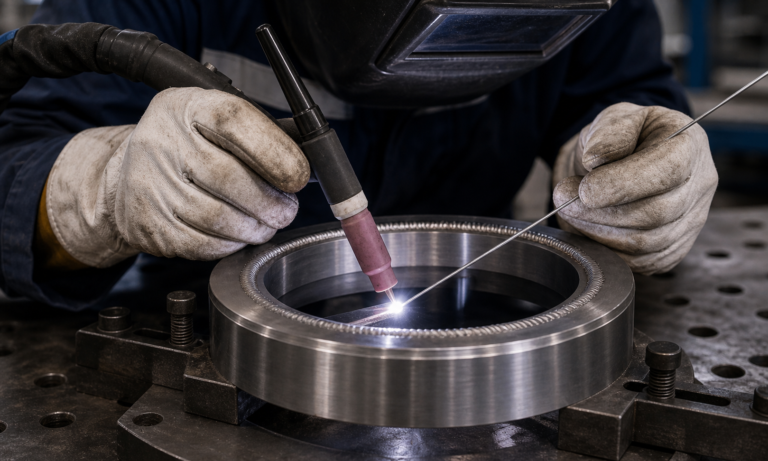
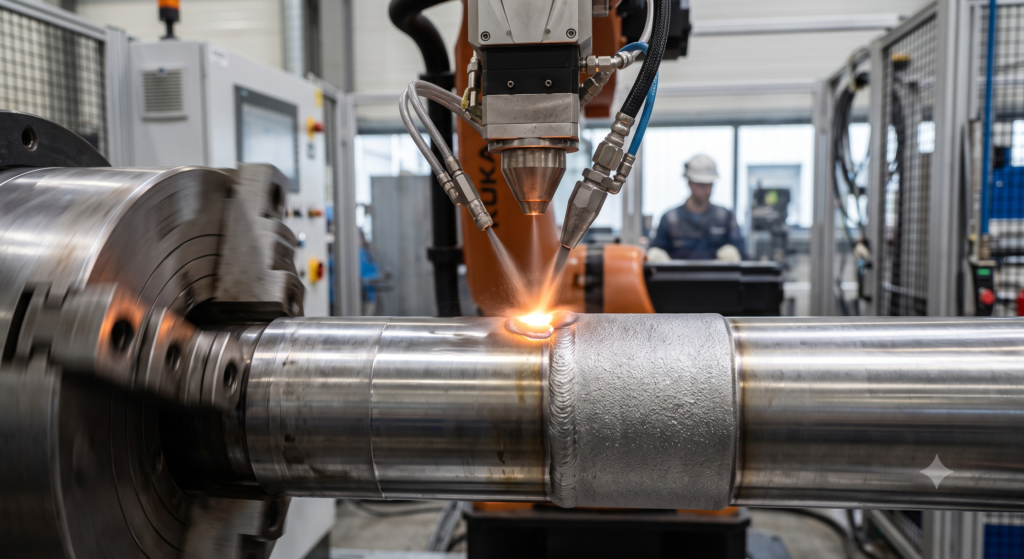
In powder form, Stellite 6 is applied by thermal spray, plasma transferred arc (PTA) welding, laser cladding, and spray-and-fuse processes. As-deposited hardness commonly falls in the 36-45 HRC range, but the value you actually measure depends on the deposition process, the degree of dilution with the substrate, and the cooling rate. A PTA overlay and an HVOF coating produced from the same powder lot will not test identically, which is why hardness should be qualified on your own process rather than taken from a datasheet.
Stellite 6 retains hardness and oxidation resistance in service up to approximately 800 degrees Celsius, and resists adhesive wear, abrasive wear, cavitation, and a range of corrosive media – the combination that makes it the most widely specified grade in the Stellite family.
Matching Particle Size to Your Deposition Process
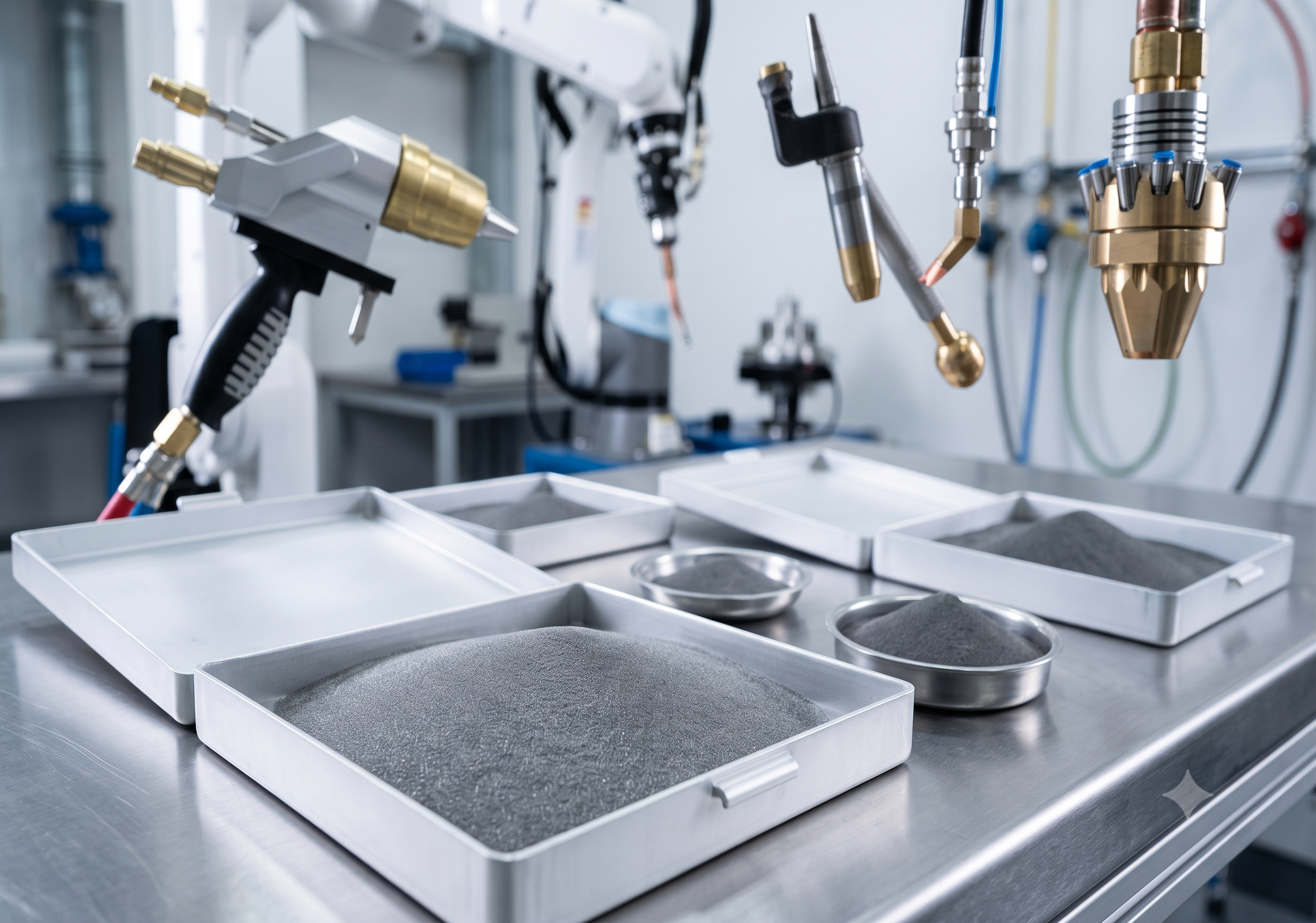
Particle size distribution (PSD) is the single most common source of mismatch when buying stellite powder. Each deposition process has a window determined by how much thermal energy is available and how long the particle stays in it. Typical ranges are:
| Process | Typical PSD | Why this range |
|---|---|---|
| HVOF | -45 +15 µm | Very short dwell time in the jet; fine spherical particles are needed to heat fully and build dense, low-porosity coatings |
| Plasma spray | -90 +45 µm | Higher available flame energy tolerates a coarser feed |
| Laser cladding | -150 +45 µm | Coaxial and lateral nozzles require free-flowing powder; excessive fines disturb the powder stream and adhere to optics |
| PTA welding | -180 +53 µm | Coarser particles resist blow-away in the arc and support higher deposition rates |
| Spray and fuse | -106 +45 µm | Balances feed consistency against fusibility during the fusing step |
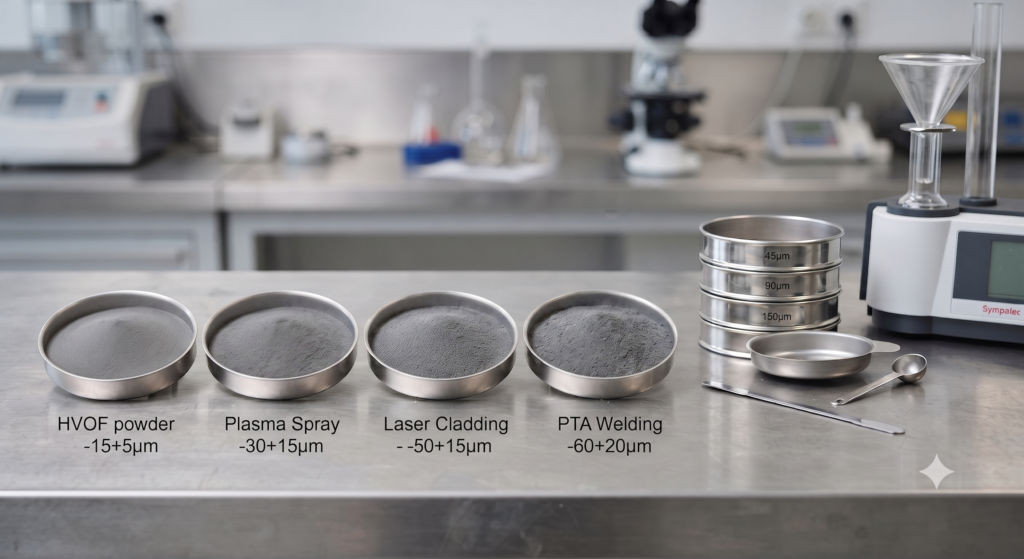
Treat these as starting points, not specifications. Feeder design, nozzle geometry, and gas parameters vary between machines, so confirm the range against your equipment manufacturer’s recommendation. Specifying the wrong PSD produces predictable failures: powder too fine for a PTA torch is blown out of the melt pool and wasted, while powder too coarse for HVOF arrives at the substrate incompletely melted and builds a porous, poorly bonded coating.
Beyond Chemistry: Specifications That Determine Coating Quality
Atomization Method and Particle Morphology
Gas-atomized powder is largely spherical, flows freely, and carries lower oxygen content – the preferred choice for HVOF and laser cladding, where feed consistency and coating cleanliness are critical. Water-atomized powder has irregular morphology and higher oxygen content at lower cost, and remains acceptable for some weld overlay and PTA work. Because the two are not interchangeable in a validated process, specify the atomization method explicitly rather than leaving it to the supplier.
Flowability and Apparent Density
Flowability is measured with a Hall flowmeter per ASTM B213, and apparent density per ASTM B212. Both directly affect feeder calibration: powder that flows inconsistently produces a variable feed rate, which shows up as variable coating thickness and inconsistent deposition efficiency. If you are qualifying a new supplier against an existing process, request these values so you can compare them to your current powder before running a trial.
Oxygen Content
Elevated oxygen introduces oxide inclusions at particle boundaries, reducing cohesive strength within the coating. This matters most for HVOF and laser cladding, where the deposit is expected to be dense and well bonded. Where coating integrity is critical, make oxygen content a stated requirement on the purchase order.
Lot-to-Lot Consistency
A powder that meets its nominal PSD range on paper can still drift within that range from lot to lot, and when it does, the process parameters you validated drift with it. Ask for the actual particle size analysis per ASTM B822 for the lot being shipped, not just confirmation that it falls inside the nominal band. Consistency across repeat orders is often the clearest practical difference between a specialist powder supplier and a general metals trader.
Selecting a Grade
Stellite 6 is the default choice where balanced wear and corrosion resistance is needed. Where the wear mechanism is predominantly abrasive, higher-carbon and higher-tungsten grades such as Stellite 1 and Stellite 190 offer greater hardness at the cost of toughness and weldability. Stellite 12 sits between these. Where thermal fatigue, impact, or aggressive corrosion dominates, the lower-carbon molybdenum-bearing Stellite 21 is generally more suitable than Stellite 6.
We supply cobalt-based powders across the commonly specified grades – including 1, 3, 4, 6, 12, 20, 21, 25, 31, and 190 – along with custom Co-Cr compositions developed to a customer specification. If you are unsure which grade suits your wear mechanism, describe the operating conditions and we will advise before you order.
Handling and Storage
Hardfacing powders absorb atmospheric moisture, and moisture causes both feed disruption and coating defects such as porosity. Store powder sealed in its original container in a dry environment, re-dry opened containers according to the supplier’s guidance before use, and avoid blending lots partway through a production run – a mid-job change in PSD or apparent density will shift your deposition behaviour without any obvious cause.
What to Include When Requesting a Quote
The more of the following you provide, the more accurate the first quotation will be:
- Grade required (for example Stellite 6, or a target chemistry)
- Particle size distribution range, and the process it is for (HVOF, plasma spray, PTA, laser cladding, spray and fuse)
- Atomization method: gas atomized or water atomized
- Quantity – trial lot for qualification, or production volume
- Packaging requirement, including container size and sealing
- Certification required: chemical analysis, particle size analysis, apparent density and flow rate
Why Supplier Selection Matters
A marginal powder lot is rarely identified on receipt. It is identified after the powder has been sprayed onto a production component, when stripping and recoating cost far more than the powder itself – and when the schedule impact is already unavoidable. That asymmetry between purchase price and failure cost is the reason to weigh supplier capability ahead of unit price:
- Specialisation in cobalt alloys rather than general metals trading
- Ability to supply a consistent PSD across repeat orders, with lot documentation to prove it
- Complete certification: chemical analysis, particle size analysis, flow and density data
- Trial quantities for qualification before a production commitment
- Responsive technical support in English when a process issue needs to be diagnosed quickly
Talk to Us About Your Requirement
Whether you are qualifying stellite 6 powder for a new coating process or looking to secure more consistent supply for an existing one, send us your specifications and we will respond within 24 hours.
Send an inquiry using the form on this page – or reach us directly:
- Email: sales@stecometals.com
- WhatsApp: +86 136 7477 1335 (fastest response)
Trial quantities are available for process qualification before you commit to a production order, and every shipment includes chemical analysis and particle size documentation. Coating specifications and current powder datasheets are welcome – if you tell us what you are using now, we can quote a directly comparable powder.
Particle size ranges shown are typical industry starting points and should be confirmed against your equipment manufacturer’s recommendations. Test methods referenced: ASTM B212 (apparent density), ASTM B213 (flow rate), ASTM B822 (particle size distribution). Contact us for current pricing and lead times.